

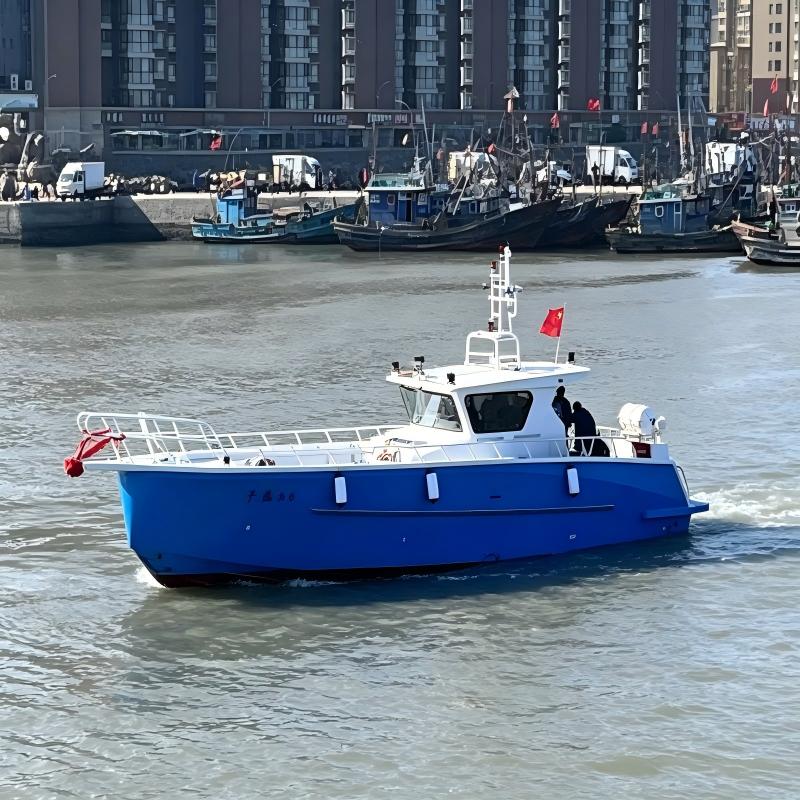

Equipped with excellent maneuverability and high-speed response capability, our maritime rescue work boat features superior shock resistance and rapid rescue efficiency. It fully adapts to complex operating scenarios, including inland rivers, ports, and near-sea waters, serving as core emergency equipment for coast guard teams, marine fire departments, port management authorities, and scenic area water safety departments. Standard full set of marine navigation and communication systems, professional search and rescue devices, and on-site medical facilities enable the vessel to execute reliable rescue missions in harsh weather and complex sea conditions. Meanwhile, we support modular custom rescue equipment configuration, including life-saving systems and underwater detection devices to meet personalized operational demands.
Professional Rescue Operation Configuration
Hull & Rescue Deck
Self‑draining diamond anti‑slip rescue‑deck with dedicated stretcher fixation points, designed to shorten on‑site rescue handling time. High‑density foam fenders surround hull for collision buffering during emergency alongside operation. Automatic bilge pump prevents water accumulation on deck.
Wheelhouse & Observation
360° panoramic blind‑spot‑free wheelhouse for full‑situation observation during rescue operation. Shock‑absorbing crew seats reduce crew fatigue during long‑time emergency missions. Warning lights and loudspeaker support night‑time search and on‑site public warning.
Navigation & Rescue Outfit
Standard navigation and communication equipment guarantees all‑weather rescue operation. Rescue‑related devices can be expanded modularly for fire‑fighting, oil‑spill recovery and underwater search tasks.

Core Competitive Advantages of Aluminum Rescue Work Boat
Rapid Emergency Response Capability: Lightweight aluminium‑alloy hull delivers faster acceleration compared with steel or fiberglass rescue vessels of equal size. Shorten arrival‑on‑scene time and improve rescue success rate during sudden maritime accidents or flood disasters.
All-water coverage operation capability: The combination of shallow draft design and impact-resistant hull enables it to operate in complex waters such as urban areas and rocky areas, expanding the rescue scope.
High space utilization and high load capacity: The thin-walled structure can maximize the utilization of internal and deck areas. Under the same tonnage, it can carry more rescue personnel, equipment and evacuees, and support the simultaneous operation of multiple tasks.
Low cost and low maintenance advantage: The aluminum hull is corrosion-resistant, has a long service life, and does not require regular rust removal and repainting. Damaged hulls can be directly repaired with local welding, reducing maintenance costs and downtime. At the same time, the lightweight hull has low running resistance, and compared to steel rescue boats of the same size, fuel consumption is reduced by up to 25%, effectively reducing the daily operational costs of the rescue team.
High rescue safety: The hull has excellent collision safety performance, will not fracture or crack, avoiding secondary injuries to rescue personnel due to hull rupture, and reducing the risk of sinking after being hit. The fire-resistant property of aluminum can prevent the spread of fire in fire rescue tasks, improving on-site safety.
Flexible customization: By replacing load modules, multiple functions can be converted, such as search and rescue, law enforcement, patrol, fire fighting, material transportation, engineering support, etc. This reduces the repeated investment in equipment. Comprehensive multi-dimensional customization can be carried out according to the needs of coast guard, fire department, scenic area and port management authorities, with personalized customization of size, power configuration, cabin layout, rescue equipment and appearance color.
Global export adaptability advantage: Provide CCS, CE, DNV and other classification society certification services, equipped with complete test reports and factory inspection certificates, meeting the import regulatory requirements of various countries.
Stable Batch‑production Quality: Digital CNC cutting, standardized welding process and 100 % weld non‑destructive‑testing ensure consistent quality for single‑unit or large‑volume government‑procurement orders.
Application Scenarios
- Maritime search & rescue for drowning victims and ship‑accident survivors
- Flood & typhoon disaster‑relief: personnel evacuation and emergency‑material delivery
- Port‑area emergency response: ship‑fire assistance, oil‑spill on‑site handling
- Water‑way security patrol & law‑enforcement
- Large‑scale water‑event on‑site safety‑guarantee
- Underwater search, salvage and diving‑support auxiliary tasks
- Water‑conservancy and offshore‑wind‑farm inspection support

Basic Parameter
|
Length |
14.8m |
Width |
3.3m |
|
Depth |
1.7m |
Displacement |
28t |
|
Speed |
20-25kn |
Waterline |
11.2m |
|
Material |
Al-mg alloy 5083-H116 |
Max Crew |
12Persons |
Package And Transport
This 14.8-meter aluminum rescue work boat exceeds the inner diameter of standard containers. Considering the characteristics of the rescue boat, such as numerous precision electronic devices and the presence of special life-saving equipment, a special protection and transportation plan has been formulated to support global port deliveries and ensure that the equipment arrives at the port in good condition.
Package
The outer walls of the vessel are fully covered with PE static protection film. Thick bubble films and solid wood corner guards are added to the high-risk collision areas. All precision equipment is disassembled with bolts and independently packed in shockproof and moisture-proof wooden boxes. Rescue equipment is classified and packaged separately; life-saving equipment is individually sealed in accordance with international maritime dangerous goods regulations. The interior is treated for moisture prevention. The fuel tank retains no more than 10% of the emergency fuel volume, and the freshwater tank is emptied. The wooden packaging complies with regulations for safety.
Transport
Roll-on/roll-off ship transportation.
Operation method: The rescue boat is fixed on a custom-made steel transport frame. A low flatbed trailer carries the entire vehicle and drives onto the ship's tail ramp to enter the enclosed vehicle deck of the roll-on/roll-off ship. There is no lifting operation throughout the process.
Supporting guarantees: Provide a professional binding plan recognized by the shipowner, track the shipping schedule throughout the process, and regularly report the transportation status.
Production Technology Process
1. Ship structure and production drawing design
2. Material preparation
3. CNC cutting and precise cutting
4. Assembly of ship sections
5. Final shaping of the hull
6. Professional welding
7. Inspection of welds, dimensions, and structure
8. Surface grinding and oxidation treatment
9. Ship painting
10. Installation of power systems and other equipment
11. Sea trial and operation testing twelve
12. Final inspection & factory delivery
FAQ
Q1: What classification‑society certification can you provide for this rescue work boat?
A: Hull welding follows CCS technical‑specifications. CCS, CE or DNV vessel‑survey certification can be arranged to meet local government procurement requirements.
Q2: Are rescue devices such as fire‑monitor and underwater sonar included as standard?
A: First‑aid kit, search‑light and basic lifesaving‑gear belong to standard scope. Fire‑fighting set, oil‑spill‑recovery and underwater‑sonar are optional modular‑mission upgrades.
Q3: Can we swap mission‑modules to switch between rescue, fire‑fighting and patrol tasks?
A: Yes, this rescue‑work‑boat supports modular‑equipment refit to satisfy different emergency‑mission scenarios.
Hot Tags: rescue work boats, China rescue work boats manufacturers, suppliers, factory,14.8m Rescue Work Boats,5083‑H116 aluminum rescue work boat, Drone Work Boat, Remote Control Work Boat, Service Work Boat, Unmanned Work Boat, Utility Transport Boat, work boats


