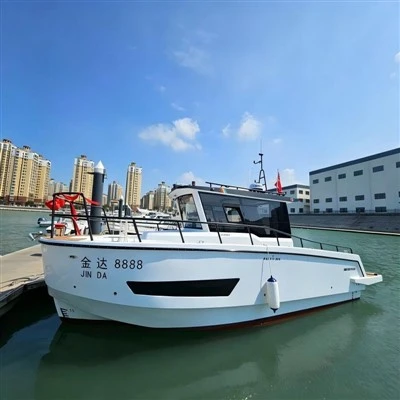

Commercial Work Boats: Specifications for Transport, Service and Marine Operations
Work boats are purpose-built commercial vessels used for practical marine tasks rather than recreational use. Typical duties include crew transport, equipment handling, port service, offshore maintenance, aquaculture support, marine inspection, and nearshore construction.
For a work boat, the correct specification depends on the operating environment and the job to be performed. Hull dimensions, payload, deck arrangement, propulsion, fuel capacity, draft, stability, and onboard equipment must work together cohesively.
We engineer and supply customizable work boat configurations for commercial and industrial applications, with vessel specifications developed around intended operating conditions and customer requirements.
-
![Harbor Work Boats]() Harbor Work BoatsBuilt to withstand frequent intensive inshore maritime tasks, our 13.9m harbor work boat serves as a reliable multi-purpose utility vessel for port terminals, anchorage zones and offshore...
Harbor Work BoatsBuilt to withstand frequent intensive inshore maritime tasks, our 13.9m harbor work boat serves as a reliable multi-purpose utility vessel for port terminals, anchorage zones and offshore... -
![Transport and Maintenance Boats]() Transport and Maintenance BoatsOur 16.88m transport and maintenance boat is built to handle heavy-duty offshore service tasks across ports, wind farms, oil & gas platforms and marine construction sites.
Transport and Maintenance BoatsOur 16.88m transport and maintenance boat is built to handle heavy-duty offshore service tasks across ports, wind farms, oil & gas platforms and marine construction sites.
Constructed... -
![Aluminum Pilot Boats]() Aluminum Pilot BoatsDeveloped to meet strict international port pilot operation standards, our 16.68m aluminum pilot boat serves as the core transportation vessel for major coastal terminals, busy container harbors...
Aluminum Pilot BoatsDeveloped to meet strict international port pilot operation standards, our 16.68m aluminum pilot boat serves as the core transportation vessel for major coastal terminals, busy container harbors... -
![Rescue Work Boats]() Rescue Work BoatsOur 14.8m rescue work boat is a professional multi-functional emergency vessel tailored for maritime search and rescue, emergency response, port security patrol, and water disaster relief...
Rescue Work BoatsOur 14.8m rescue work boat is a professional multi-functional emergency vessel tailored for maritime search and rescue, emergency response, port security patrol, and water disaster relief... -
![Tug Work Boat]() Tug Work BoatOur 19.9m aluminum tug work boat is a versatile, heavy-duty professional vessel specifically designed for port operations, coastal towing, offshore engineering support, and emergency response...
Tug Work BoatOur 19.9m aluminum tug work boat is a versatile, heavy-duty professional vessel specifically designed for port operations, coastal towing, offshore engineering support, and emergency response... -
![Unmanned Work Boat]() Unmanned Work BoatOur 5.3m unmanned work boat, also referred to as USV (Unmanned Surface Vehicle), is a remotely operated automated platform built to carry out maritime patrol, water environmental monitoring,...
Unmanned Work BoatOur 5.3m unmanned work boat, also referred to as USV (Unmanned Surface Vehicle), is a remotely operated automated platform built to carry out maritime patrol, water environmental monitoring,...


Work Boat Selection Starts With the Operating Task
A work boat should be selected according to its primary duty rather than by size or maximum speed alone.
|
Operating Requirement |
Key Selection Considerations |
|
Crew transport |
Passenger capacity, seating arrangement, speed, weather protection |
|
Equipment transport |
Payload, deck area, deck loading, access and securing points |
|
Port service |
Maneuverability, draft, visibility, working deck, and propulsion |
|
Marine maintenance |
Deck layout, equipment capacity, stability, and onboard storage |
|
Aquaculture support |
Working deck, payload, corrosion protection, and low-speed handling |
|
Offshore service |
Fuel capacity, range, sea conditions, crew capacity, and equipment |
|
Inspection and patrol |
Visibility, maneuverability, endurance, and communication equipment |
|
Nearshore construction |
Payload, deck strength, stability, and equipment integration |
Work boats can be configured for different commercial marine tasks. Common configurations include:
Utility Work Boats: Provide an open or partially configured working platform for general marine operations, equipment transport, maintenance, and inspection where deck flexibility is critical.
Crew and Service Boats: Configured primarily for transporting personnel between shore facilities, vessels, offshore installations, or work sites, prioritizing seating comfort, safe boarding access, and weather protection.
Port and Harbor Work Boats
Designed for terminals, docks, marinas, and port facilities where compact dimensions, high maneuverability, excellent visibility, and precise low-speed control take priority over maximum cruising speed.
Transport Work Boats
Offer additional deck or cargo capacity for tools, materials, and heavy equipment, balancing payload distribution with hull stability.
Specialized Work Boats
Configured around project-specific equipment or operating procedures, including environmental response, marine research, and industrial support duties.
Key Technical Parameters for Procurement
A commercial work boat must be evaluated using a complete technical specification rather than a single headline parameter.

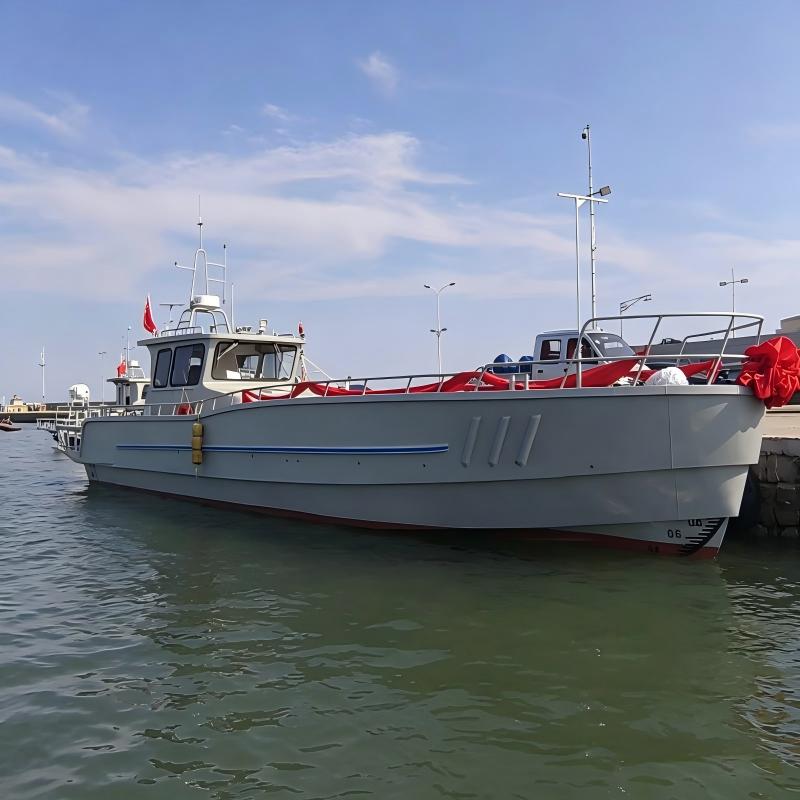
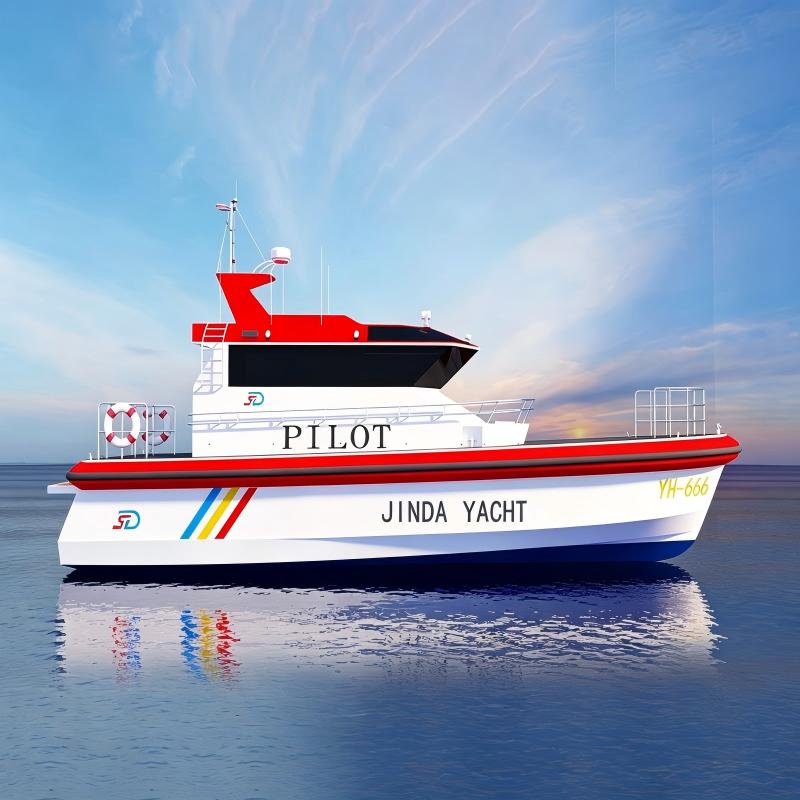
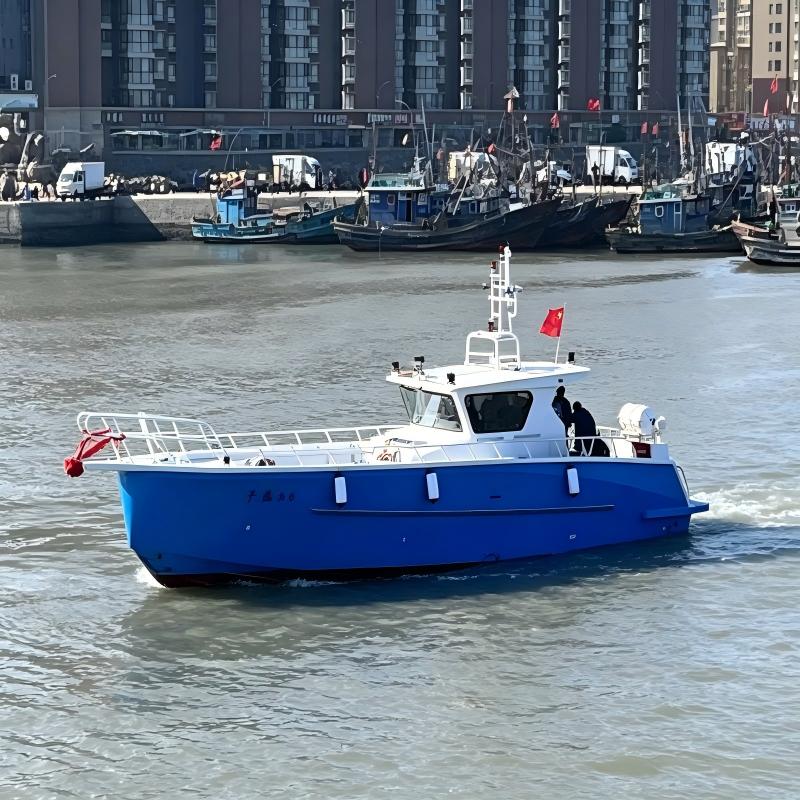
Principal Dimensions
Important dimensions include overall length, beam, draft, freeboard, hull configuration, and displacement (operating weight). These affect transport logistics, maneuverability, stability, loading capacity, and access to shallow-water operating areas.
Payload and Deck Capacity
Payload must account for personnel, fuel, tools, equipment, spare parts, and other operational loads. For vessels with large open decks, buyers should confirm:
Usable deck area and permitted deck loading limits
Load distribution and equipment mounting requirements
Cargo securing arrangements and access for loading/unloading
Propulsion System
Propulsion selection directly affects acceleration, cruising speed, fuel consumption, maneuverability, and maintenance. Specifications should identify:
Main engine type, rated power, and number of engines
Propulsion arrangement (shaft line, stern drive, or waterjet configuration)
Gearbox, steering system, fuel capacity, and cooling arrangement
Speed and Range
While maximum speed matters for time-sensitive crew transfers, commercial buyers should evaluate normal operating speed, cruising speed, fuel consumption at working speed, and overall operating endurance.
Hull Construction and Material
Hull material and construction methods determine structural strength, corrosion resistance, and service life. Specifications cover plate thickness, structural reinforcement, welding procedures, surface preparation, and coating systems. Compliance with recognized international standards and class guidelines (such as ABS, DNV, or BV rules) can be integrated based on project requirements.
Customization Options
Commercial work boats are engineered-to-order products. Customization options cover cabin layouts, seating arrangements, open working decks, marine electronics, hydraulic equipment, towing hooks, and custom deck fittings to align perfectly with specific operational profiles.
Frequently Asked Questions
With abundant experience, we are one of the most professional work boats manufacturers and suppliers in China. Please feel free to buy high quality work boats made in China here from our factory. We also accept customized orders.
Popular Products