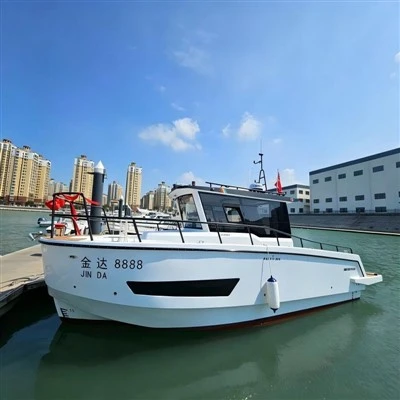
Catamarans have two hulls running parallel, resulting in a wider stability baseline. When encountering external forces such as wind and waves, the two hulls of a catamaran can collectively provide a larger support area, thereby reducing the degree of heeling. For example, in some rough sea conditions, catamarans can still maintain a relatively stable sailing attitude. Furthermore, the relatively low center of gravity of a catamaran further enhances its stability. The connection structure between the two hulls also helps to distribute external forces, improving overall resistance to heeling.
Support Area: The parallel hulls of a catamaran significantly increase the support area. In contrast, a monohull has only one hull in contact with the water. Under the same external forces, a catamaran, with its wider support base, can better resist the swaying and heeling caused by wind and waves. For example, on rough seas, the two hulls of a catamaran can each absorb part of the impact force, reducing the overall sway of the vessel.
Center of Gravity Position: The center of gravity of a catamaran is typically low. Because the two hulls are distributed on both sides, the overall weight distribution is more dispersed, and the center of gravity is relatively lower. A lower center of gravity makes catamarans more stable during navigation and less prone to capsizing due to external forces. Monohulls, on the other hand, have a more concentrated center of gravity, making them more susceptible to imbalance when subjected to larger external forces due to a shift in the center of gravity.
Structural Force Dispersion: The connecting structure between the two hulls of a catamaran plays a crucial role. It distributes external forces across both hulls, preventing excessive stress on any single area. When subjected to wind and waves, the connecting structure transfers and disperses the force, reducing damage to individual hulls and maintaining the overall stability of the vessel. Monohulls lack this force-dispersion structure, making them more susceptible to localized damage and instability when faced with the same external forces.